Summary (So Far)

I messed around with electronics quite a bit as a kid. I’d put things together according to diagrams, and if they didn’t work, I’d change something and see what happened, and get a feeling for what was happening inside the black box.

When I started doing audio electronics in earnest, I found the oscilloscope. Here’s a cool handmade one by Andrew Smith.
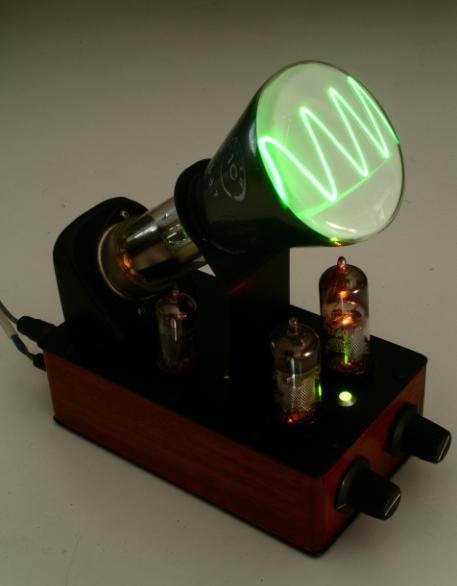
An oscilloscope is a powerful tool, a visualizer, that lets you look right into the black box. It feels almost like cheating. All the energy that went into detective work can now be put to creative purposes. Electronics is much easier when you can directly see what’s happening in there.

I feel that hearing the notes in their untempered form, and learning their relationships on the lattice, has connected me with music in a similar way. Was blind, but now I see.

I’ve finished my first goal for this blog — to create and post the Flying Dream video, and post enough information for an interested person to understand it. I could go on for a long time about the uses of the lattice, and I imagine I will. It’s a fabulous tool.

There will be a slight pause in this blog as I write and rehearse for some upcoming shows. I intend to be back with some new subjects, especially an exploration of consonance and dissonance. If this work interests you, and you’d like to discuss it, you can reach me through the contact page.

Oh, and the matrix in which all of this is happening is love.

Next: Mozart on the Lattice

Similar Posts

  • The Major Seventh

    The notes get more exotic as you move outward from the center. The ninth is quite consonant, but not nearly as consonant as the fifth. (Consonance and dissonance are descriptions of feelings; they are part of the flavor of an interval, and I don’t think the last word has been written on them yet. I’ll be…

  • The Minor Second

    The last three notes (b6, b3 and b7) are related to each other. They all contain a reciprocal third. There is a family resemblance of sound and function. (They also all happen to be a little flat in equal temperament. On a guitar it’s a nice trick to bend them a little to sweeten them.)…

  • A Theory of Everything

    Hey, shouldn’t everyone have one? I’ve suggested many times on this blog that number is at the heart of all things. Here’s one article: Pythagoras’ Epiphany. I think the beauty of music, especially harmony, is similar to the beauty of math, but happening in real time. It slightly parts the veil, deepening the view of what…

  • |

    The Blue Tritone

    I have a favorite note. Don’t tell the others. It’s the septimal flat five, or septimal tritone. I call it 7b5 on the lattice. There are many reasons why I love this note. One is that Jimi played it, and he’s my favorite musician of them all. Another is that this note is rarely discussed…

  • |

    Compound Notes

    Multiplying the tonic by 2, 3 and 5 creates the octave, fifth and third respectively. The ear hears these intervals very well. We can easily sing them. Each one has a feel, a sort of harmonic flavor, that makes a fifth a fifth and a third a third. It turns out that the ear can…

Leave a Reply

Your email address will not be published. Required fields are marked *