Extending the lattice
As I’ve analyzed my songs on the lattice, and written new music using it as a tool, I have found that I have a certain palette of notes in my mind, a territory of the lattice that I can hear and think with. The notes in this portion are distinct individuals for me. Each one has its own personality, a distinct mix of attraction, repulsion, beauty and function. I’ve described and given examples of many of them.
When I wrote Flying Dream in 1981, I was consciously trying to write a song that used all twelve notes of the chromatic scale. The first part of making the Flying Dream animation was to reverse-engineer my own song, figuring out with my new tool (the lattice) what I had been instinctively hearing at the time.
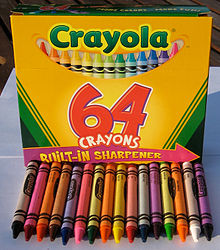 It turned out that I had been hearing about 18 notes in the song, including blue notes, and notes up in the northern part of the lattice. That made sense. I remember, as a kid, being disappointed to find out that there were only 12 total notes in music to work with. It seemed to limit the possibilities, like being stuck with the 8-color Crayola box.
The music I love to listen to, and make, has the big 64-color box with built-in sharpener. What’s up with Mick Jagger’s “Oooooh,” at the beginning of Gimme Shelter, or that guitar lick in Dizzy Miss Lizzy? These notes can’t be found on the piano, unless you have a pitch bend wheel. Check out this clip of Ray Charles bending notes in 2000 — now there’s a use of technology! The mystery of those notes, and others like them, has stuck with me, and now I feel like I’m getting to know them as friends.