Leading the Ear
Be Love was written and arranged on the lattice. I consciously used the lattice as a tool to make the music do what I wanted it to do.
Working with this song has taught me a lot about leading the ear.
Different parts of the lattice have different sounds. The upper right, the northeast, is major scale territory. Music in this zone sounds major, you know, that uplifting, stable, “happy” majorness. The northwest region, up and to the left, has a darker, dramatic sound, not like minor, but with its own flavor. It shows up a lot in rock. A great example is BTO’s Taking Care of Business. The progression is I, bVII-, IV, I. (I use numbers for notes and roman numerals for chords.)
I wanted the song to start in the northwest for the verse, and then move eastward for the chorus, and then go back again, and I wanted to choose notes that would lead the ear on the journey.
Here’s the beginning. The chords plant a flag in the Northwest.
The music stays there for a while, and then it starts to move. The chord progression changes, and the guitar melody reaches out to the east and starts to rope in more territory.
Finally, right before the chorus, the V chord takes the song firmly into dominant territory.
Notice how the melody leads the way into the far east. When the melody goes to the 2, in advance of the chord progression, it sets up tension. The tension is resolved when the root moves up to the 5 and creates a more consonant interval.
One of the pleasures of these lattice movies is watching the fleeting, exotic harmonies that are formed as the melody dances around the basic chords. This chord is a type of sixth chord.
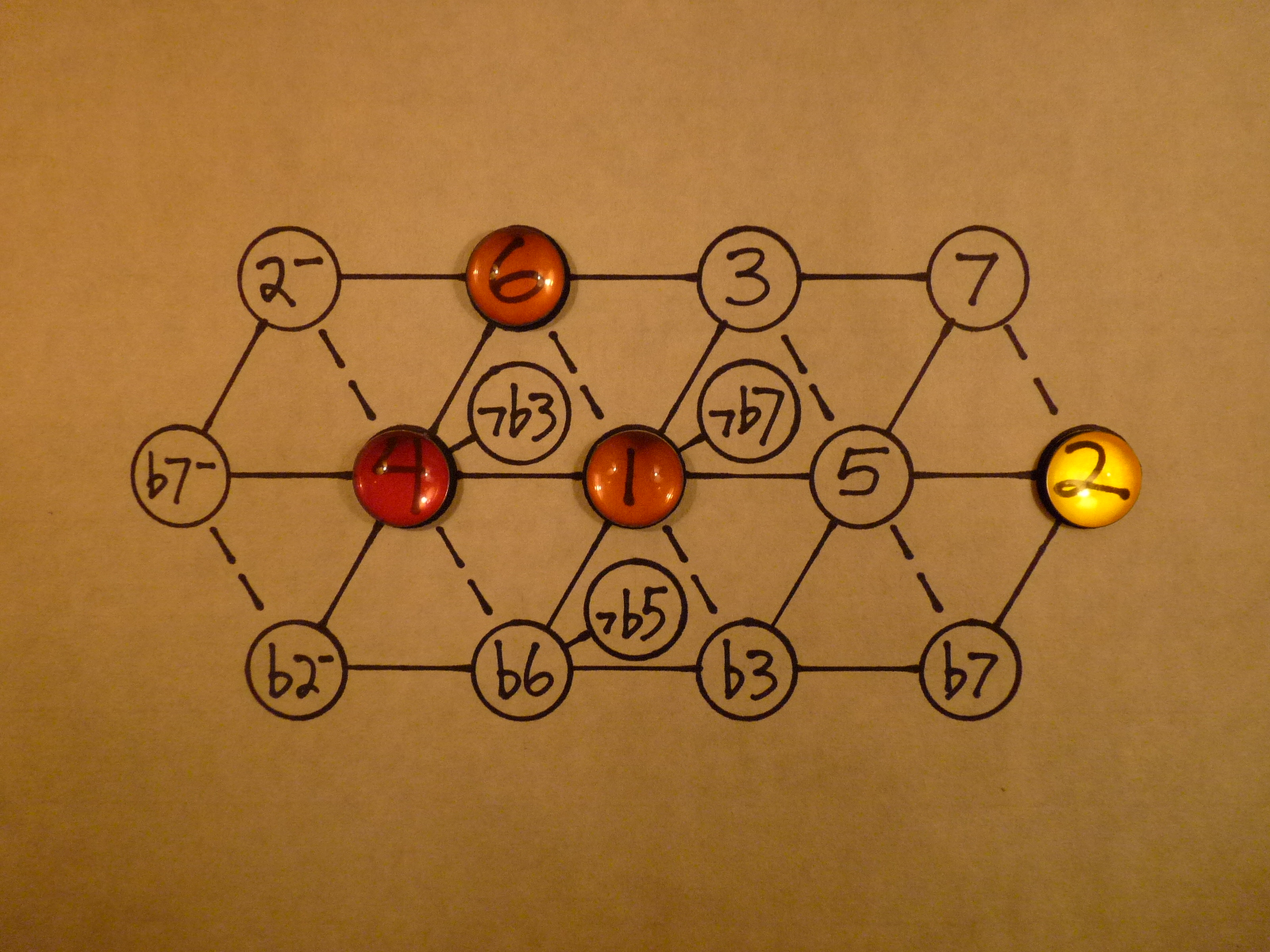
When 4 is the root, 2 is its sixth degree. I call the interval between 4 and 2 a Pythagorean sixth, because it is generated entirely by multiples of 3 — a characteristic of Pythagorean tuning. The ratio, octave reduced, is 27/16. It sounds different than the 5/3 sixth, and is tuned sharper — 906 cents instead of 884.
The Pythagorean sixth chord leads the ear to the east. The tension of the 2 in the melody is resolved by moving all the music up to meet it.
Now there’s a new tension, against the tonic, which is in the back of the listener’s mind all the time. I will want to resolve this tension by collapsing to the center, but first I want to increase it as much as possible. I want to dive into the chorus from a great height.