The Untempered Chromatic Scale (Part 2)
A closer look at the untempered 12-note scale reveals some interesting patterns.
Here’s the scale on the lattice again. This time, I’ve colored the notes as follows:
Red = notes from the central, Pythagorean row, or spine, of the lattice. They are generated by multiplying and dividing by 3.
Green = notes from the next row up. These notes are a major third up from the ones on the central spine — you generate them by multiplying by 5.
Blue = notes from the row below the central one. You make these by dividing by 5, which means they are a major third below.
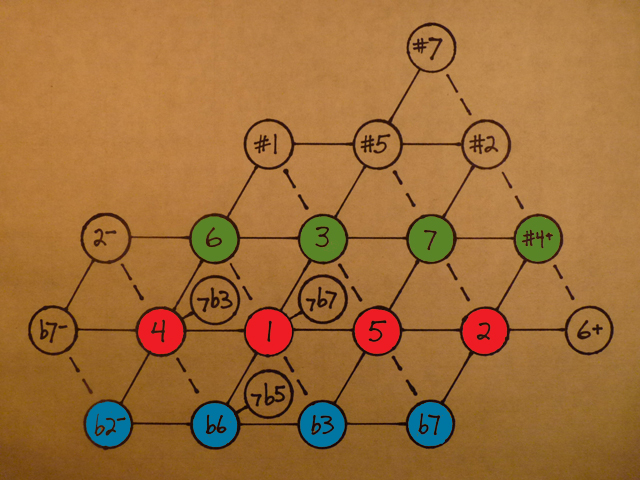 Now here’s the scale again, colored the same way.

Notes in red are tuned about the same as their equal tempered counterparts.
Notes in green (the majors) are all flatter than ET.
Notes in blue (the minors) are all sharper than ET.
OK, so what? I can think of several immediate ways to use this information.
If you are a singer/guitar player, remember that you can only bend notes up. You can make your guitar playing sweeter if you:
- Avoid bending roots and fifths, play them right on the money
- Bend minor thirds slightly, and
- For sure don’t bend major notes. It actually helps to mute or avoid major thirds in your guitar playing, and leave those to the vocal. There are several ways to play a G chord, for example. Try singing a simple song in G (maybe Silent Night or Ring of Fire), using the classic G chord:
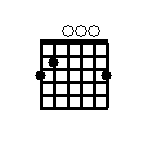
There are two equal-tempered major thirds in this chord.
Now try it fingering this way:
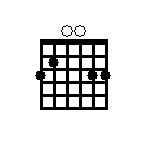 For even more clarity, mute the 5th string with your left hand, and there will be no major thirds in the chord at all. It is all G and D notes, roots and fifths. Can you feel the difference in your singing? There is a division of labor: the guitar plays the notes that are in tune in ET, and the voice sings the rest, including that major third. I think you will find it much easier to sing, like your voice falls into a pocket instead of fighting the intonation of the guitar.
Gotta go, I have a show tonight, but I’ll have a lot more to say about this sort of thing. I do welcome comments and questions, there’s a contact page and you are invited to email me if you’d like to discuss this stuff.